

Kitchen chimney not sucking smoke properly? You switch on the chimney, start tempering the dal, and within seconds the kitchen fills with smoke and the smell of frying. The motor is humming, the light is on, yet very little is being pulled up. This is one of the most common kitchen complaints in Indian homes, where heavy, oil-rich cooking puts a lot of load on a chimney.
The good news is that weak suction often comes from simple, fixable issues such as clogged filters or the wrong speed setting. Troubleshooting in the right order saves you from paying for repairs you do not need, and helps you spot problems that really do need a technician.
Quick Answer
A kitchen chimney not sucking smoke usually has one of these causes: grease-clogged filters, a blocked or badly routed duct, a weak motor or blower, a wrong suction setting, or poor chimney-to-hob placement. Start with these first checks:
- Switch off the chimney, then inspect and clean the filters as per your manual.
- Try a higher speed or boost mode.
- Check that the outlet or duct is not visibly blocked or crushed.
- Keep a window slightly open so fresh air can replace extracted air.
If suction is still weak, the duct, motor or installation may need professional diagnosis.
Why Is My Kitchen Chimney Not Sucking Smoke Properly?
A chimney works like a one-way path: the fan pulls smoky air through the filters, pushes it through the duct, and releases it outside. Suction drops when any part of that path is restricted, or when the chimney cannot capture smoke at its source.
Think of it like drinking through a straw. A clogged filter is a blocked tip, a crushed duct is a pinched straw, and a weak motor is a weak breath. Even a perfect motor cannot move much air through a restricted path. That is why a chimney can sound powerful and still perform poorly, which is a typical chimney airflow problem. For a general overview of how extraction hoods work, see this explanation of range hoods.
7 Common Causes and Their Fixes
1. Grease-Clogged Chimney Filters
- Common symptoms: Smoke lingers, the chimney feels noisy but weak, oil drips from the filter area, or a greasy smell remains.
- Possible reason: Oil and fine particles build up on the filter and block airflow. This is the most common cause of a clogged chimney filter.
- What you can safely check: Switch the chimney off at the switch, let it cool, and look at the filter. If it is dark, sticky or dripping, it needs cleaning.
- Recommended fix: Remove the filter only as shown in your manual. Soak it in hot water with a mild dishwashing liquid or a degreaser the manufacturer allows, gently scrub with a soft brush, rinse, and dry completely before refitting. Avoid harsh chemicals or abrasive scrubbers unless the manual permits them, as they can damage the filter.
- When to call a technician: If the filter will not come out, is damaged, or suction stays weak after cleaning.
2. Blocked or Crushed Exhaust Duct
- Common symptoms: Smoke or smell returns into the kitchen, the outlet flap barely opens, or the chimney seems to “push back”.
- Possible reason: A kinked, flattened or oil-choked duct, or an outlet blocked by dust, a bird nest or a stuck flap, restricts airflow. The air has nowhere to go, so smoke removal drops sharply.
- What you can safely check: From the kitchen, look at the visible part of the duct for dents, sharp kinks or loose joints. Check that the outside flap opens freely, only if you can reach it safely from a stable, safe position.
- Recommended fix: Straighten or replace damaged duct sections and clear the outlet. Do not climb ladders or lean out of high windows to do this.
- When to call a technician: If the duct runs inside a wall or ceiling, is hard to reach, or needs replacement.

3. Incorrect Duct Installation or Too Many Bends
- Common symptoms: Suction was never good since installation, or got worse after the chimney was shifted or the kitchen was renovated.
- Possible reason: Every bend, long run or narrow section adds resistance. Long, winding ducts, or ducts narrower than the chimney outlet, reduce airflow. Corrugated flexible pipes with many folds can restrict air more than smooth ducts.
- What you can safely check: Look at the duct path. Note how long it is, how many sharp turns it has, and whether it is the right size for the outlet. Compare with the maximum length and bends recommended in your manual.
- Recommended fix: A shorter, straighter and properly sized duct generally performs better. Re-routing should be done by an installer, not as a DIY job.
- When to call a technician: If the layout is complex or you need duct changes. A kitchen chimney repair service can assess the duct path and suggest options.
4. Chimney Motor or Blower Problem
- Common symptoms: Grinding, rattling or humming sounds, slow fan speed, the fan stopping at times, or very weak airflow even with clean filters and a clear duct.
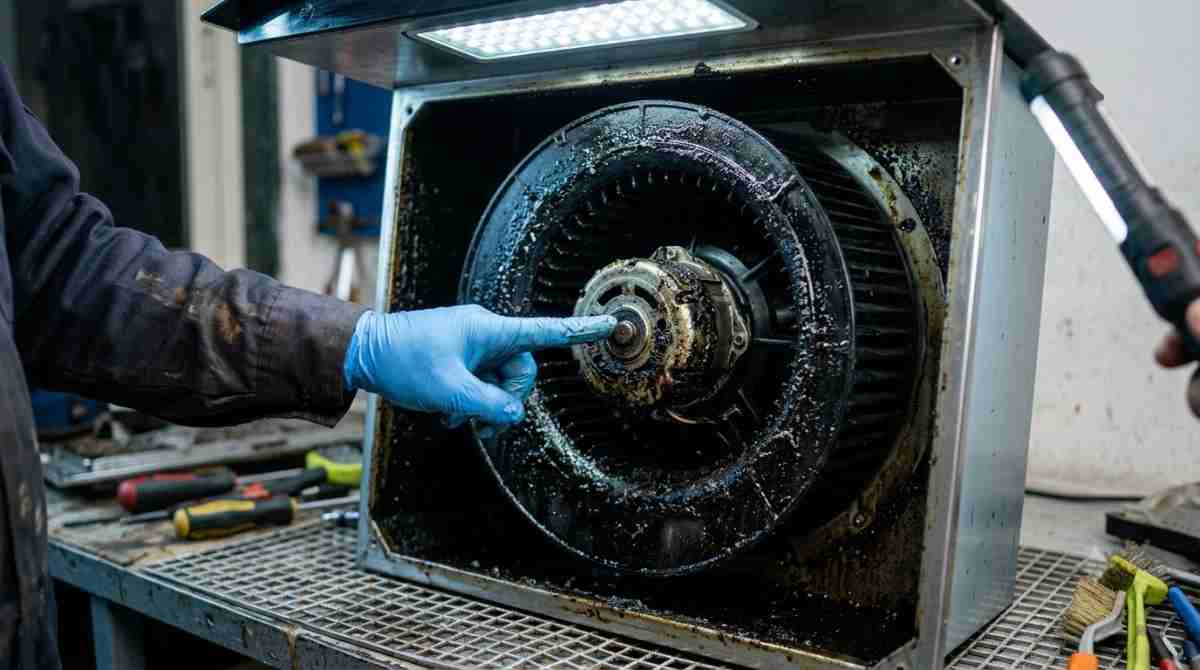
- Possible reason: Oil can coat the blower blades and bearings, upsetting balance and reducing performance. The motor may also wear out with age or heat.
- What you can safely check: Listen for unusual sounds and see whether airflow changes between speeds. Hold a thin tissue near the filter to see if it is pulled in. Do not open the chimney body or touch wiring.
- Recommended fix: Motor and blower faults need proper diagnosis. Do not attempt to repair a motor yourself unless you are qualified.
- When to call a technician: As soon as you notice noise, burning smell, tripping or no fan movement. For professional chimney repair, switch the unit off and stop using it until it is checked.
5. Incorrect Suction Setting or Unsuitable Operating Mode
- Common symptoms: Smoke escapes only during frying or tempering, but is fine during light cooking.
- Possible reason: Low speed, an eco or timer mode, or a delayed-off setting may not be enough for heavy cooking.
- What you can safely check: Use the buttons, touch panel or remote to move to a higher speed or boost, if your model has it. Check whether the unit is in a special mode. Replace remote batteries if it is unresponsive.
- Recommended fix: Use a higher speed during frying and keep it running a few minutes after cooking. Your manual explains each mode.
- When to call a technician: If buttons do not respond, speeds do not change, or the panel behaves erratically.
6. Chimney and Cooktop Placement or Excessive Distance
- Common symptoms: Smoke drifts around the sides of the chimney, or escapes from burners at the far edges.
- Possible reason: If the chimney is mounted too high, or is smaller than the hob, it cannot capture smoke effectively. A chimney that is too low can be a heat and safety concern.
- What you can safely check: Look up the recommended mounting height and size for your model in the manual, then compare it with your setup. Also note strong drafts from fans or open windows that push smoke away.
- Recommended fix: Adjusting the height should be done by a qualified installer, following the manual. Using the rear burners can help smoke capture in the meantime.
- When to call a technician: If the chimney needs to be moved or re-mounted. Never shift it yourself, especially above a gas stove.
7. Heavy Grease Buildup or Overdue Maintenance
- Common symptoms: Sticky surfaces, oil dripping from the body, a full oil collector, a rancid smell, or a steady decline in suction over months.
- Possible reason: Months of oil deposits inside the chimney, on the blower and in the oil collector reduce airflow. The filters may also be past their cleaning interval.
- What you can safely check: Empty and wash the oil collector cup, clean the filters, and wipe the outer surfaces with a damp cloth when the unit is off and cool.
- Recommended fix: Regular cleaning of filters and the oil collector. Deeper internal cleaning should be done by a trained technician.
- When to call a technician: If grease is visible inside the body, or the chimney has not been serviced for a long time. Internal cleaning is part of chimney and kitchen appliance repair in Mumbai offered by us.
Quick Comparison Table
| Problem | Common Sign | Recommended Action |
|---|---|---|
| Clogged filters | Sticky filter, lingering smoke | Clean as per manual |
| Blocked or crushed duct | Smoke or smell returns | Clear or replace duct |
| Too many duct bends | Weak suction since installation | Re-route with an installer |
| Motor or blower fault | Noise, slow fan, weak airflow | Professional diagnosis |
| Wrong suction setting | Smoke only while frying | Use higher speed or boost |
| Poor placement or height | Smoke escapes around the sides | Check manual; installer adjusts |
| Overdue maintenance | Grease dripping, gradual decline | Regular cleaning; technician service |
How to Check Your Chimney’s Suction Safely
- Switch off and cool down. Turn the chimney off at the switch and make sure the hob is cool before touching anything.
- Inspect the filters. If they are dark, sticky or dripping, clean them as per your manual.
- Empty the oil collector. A full cup can restrict flow and leak.
- Test the speeds. Turn the chimney on and compare low, medium and high. A clear difference suggests the motor responds properly.
- Try the tissue test. Hold a thin tissue near the filter. It should be pulled in firmly at higher speeds. This is only a rough check, not a measurement.
- Open a window. If suction improves, the kitchen may be short of make-up air.
- Check the outlet visually. Look for an outlet flap that is stuck or blocked, only where it is safe to do so.
When Should You Call a Chimney Repair Technician?
Call a technician if any of these apply after the basic checks:
- Suction is still weak after cleaning the filters and trying higher speeds.
- You hear grinding, rattling or loud humming from the motor.
- You notice a burning smell, sparks, or the unit trips the switch.
- The fan is slow, stops intermittently, or does not start.
- The duct is hard to reach, damaged, or the layout needs changes.
- The chimney needs to be re-mounted or the height adjusted.
If you are in Mumbai, Navi Mumbai or Thane, you can book doorstep chimney repair in Mumbai, Navi Mumbai and Thane after confirming service availability for your area. If your problem is mainly weak airflow, our page on help with weak chimney suction explains what to expect.
Please note: Appliances Repairs is an independent appliance repair service provider. We are not an authorized service centre of any brand mentioned or used by customers, and we do not claim any manufacturer affiliation. Repair outcomes depend on the model, condition and parts availability.
How to Prevent Weak Chimney Suction
Most cases of a kitchen chimney not sucking smoke can be avoided with a few simple habits:
- Clean filters regularly. For daily frying and tempering, check them every few weeks, or as your manual advises. Light cooking may need less frequent cleaning.
- Empty the oil collector before it overflows.
- Use the right speed for the kind of cooking, and run the chimney for a few minutes afterwards.
- Keep the duct short and straight where possible, and avoid crushing it during renovation work.
- Allow fresh air in by cracking a window while cooking.
- Schedule periodic servicing for internal cleaning, especially in heavy-use kitchens. Our home appliance repair services include chimney checks along with other household appliances.
Frequently Asked Questions
1. Why is my kitchen chimney running but not sucking smoke?
The motor may be working, but airflow is restricted. The usual causes are greasy filters, a blocked or crushed duct, too many bends, a low speed setting, or the chimney being mounted too high. A worn motor or blower can also be responsible.
2. Can a dirty filter reduce chimney suction?
Yes. A filter coated in oil blocks air from entering the chimney, so suction falls even when the motor is fine. Cleaning it as per the manual often improves performance.
3. How often should I clean my kitchen chimney filter?
There is no single interval. In kitchens with frequent frying, checking and cleaning every few weeks is common. Light cooking may need less. Always follow your manual, and clean sooner if the filter looks sticky.
4. Can a blocked duct cause weak chimney suction?
Yes. Air has to leave the kitchen through the duct. If it is kinked, clogged or the outlet is blocked, the chimney cannot move air properly, and smoke or smell may return.
5. How do I know if my chimney motor is faulty?
Warning signs include grinding or rattling noise, slow or uneven fan speed, a burning smell, intermittent stopping, or weak airflow despite clean filters and a clear duct. Motor faults need professional diagnosis, so avoid opening the unit yourself.
6. When should I call a chimney repair technician?
Call one if suction stays weak after basic checks, you hear unusual noises or smell burning, the duct needs changes, or the chimney must be re-mounted. A technician can inspect the filters, duct and motor safely.
Conclusion
A kitchen chimney not sucking smoke is usually telling you something specific: a choked filter, a restricted duct, the wrong setting or a tired motor. Work through the safe checks above, keep up regular cleaning, and leave electrical parts, duct re-routing and installation changes to a qualified person. If the problem remains, you can book a kitchen chimney repair service to have it properly diagnosed.
Pingback: Elica Chimney Suction Weak? 7 Possible Causes & Fixes