
Kitchen Chimney Not Suctioning? 10 Common Reasons, DIY Fixes & When to Call a Professional
Weak suction, smoke lingering in the kitchen, or a chimney that runs but doesn't seem to pull anything — here's what's usually going on, what you can safely check yourself, and when it's time to book a technician.
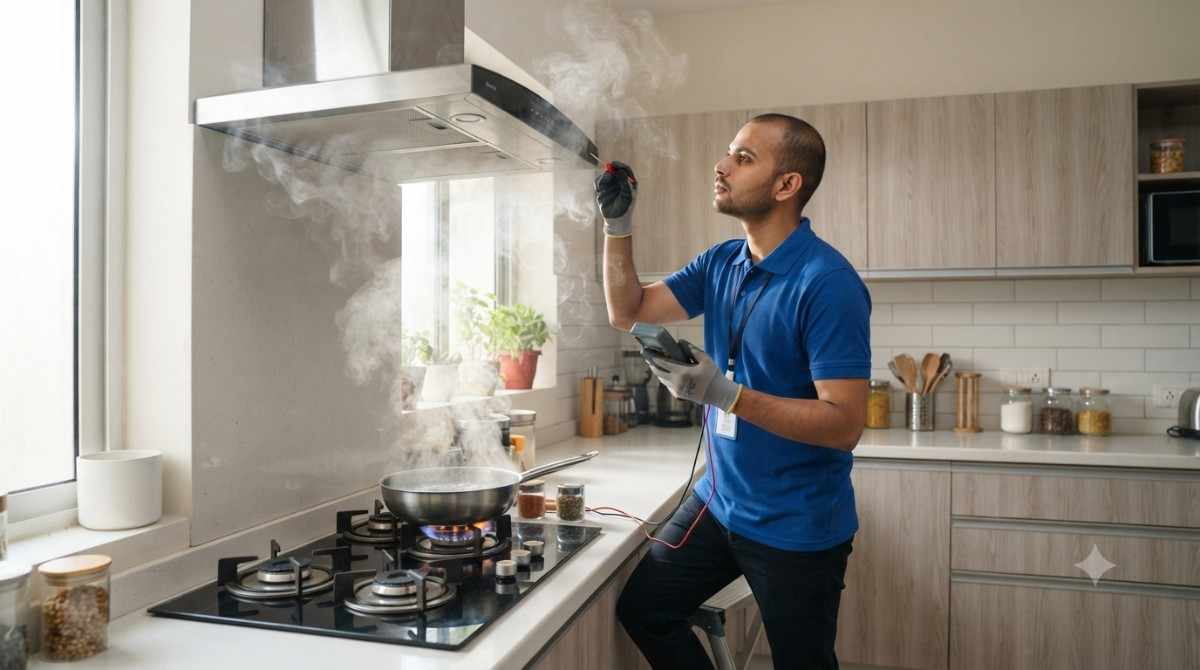
There's a specific kind of frustration that comes with cooking dinner while smoke hangs in the air instead of disappearing into the chimney above your stove. You look up, the chimney is running — you can hear the motor — but nothing's actually happening. No pull, no clearing smoke, just noise.
If that sounds familiar, you're dealing with one of a fairly short list of causes. Almost none of them mean the chimney is dying for good. Most weak-suction complaints trace back to something that's either a quick DIY fix or a straightforward doorstep repair, not a full replacement.
This guide walks through the ten most common reasons a kitchen chimney stops suctioning properly, what you can safely check yourself, and where the line sits between a DIY fix and calling in a professional.
10 Common Reasons Your Kitchen Chimney Isn't Suctioning Properly
Weak suction rarely comes from a single dramatic failure. It's usually one of these, sometimes two at once:
1. Dirty or clogged filters
This is, by a wide margin, the most common cause. Mesh and baffle filters trap airborne grease as they work, and over a few weeks of regular cooking, that grease builds into a sticky film that blocks airflow almost completely. The motor still runs at full strength — it just has nowhere to pull air through.
2. A blocked exhaust duct
The ducting that carries air outside can collect grease and dust over time, especially in installations with long horizontal runs or several bends. A partial blockage reduces suction gradually, which is why it's easy to miss until the problem is fairly advanced.
3. A damaged or worn-out blower
The blower wheel — sometimes called the impeller — physically pushes air through the unit. If a blade is cracked, warped, or coated in old grease, it can't move air efficiently even if everything else is in perfect condition.
4. Incorrect installation
Chimneys installed too high above the stove, or with ducting that runs uphill before venting outside, lose a noticeable amount of suction efficiency. This isn't a fault developing over time — it's been there since day one, which is why some brand-new chimneys already feel underpowered.
5. Motor problems
Motors do wear out, particularly after several years of daily use. A tired motor often shows warning signs first — a change in sound, a burning smell, or suction that's fine on high speed but noticeably weak on low.
6. An electrical fault
Loose wiring, a failing capacitor, or voltage fluctuations (common in some parts of Bangalore during peak load hours) can all cause the motor to run below its rated speed without any obvious external symptom.
7. A clogged carbon filter (ductless models)
If your chimney recirculates air rather than venting outside, the carbon filter absorbs odours and needs periodic replacement — not cleaning. A saturated carbon filter restricts airflow the same way a blocked mesh filter does.
8. Chimney running on the wrong speed setting
It sounds almost too simple, but it happens more often than you'd expect — a chimney left on its lowest speed setting, or with a speed-control switch that's partially failed, can feel like a suction problem when it's really a settings issue.
9. Excess grease build-up inside the unit
Beyond the filters, grease can coat the inside of the chimney body itself over months of unmaintained use, narrowing the internal airflow path even after the filters are cleaned.
10. Lack of regular maintenance
Most of the causes above compound each other over time. A chimney that's never been serviced tends to accumulate two or three of these issues simultaneously, which is why "weak suction" sometimes needs more than one fix in the same visit.
DIY Checks vs When to Call a Technician
Not every weak-suction complaint needs a service call. If the chimney hasn't been cleaned in a while, filter cleaning is worth trying first — it resolves a genuinely large share of cases on its own.
That said, there's a clear point where DIY stops being the sensible option:
- Any burning smell from the motor — stop using the chimney and get it inspected before running it again.
- Suction stays weak after a full filter clean — this usually points to the motor, blower, or ducting, not something a home fix resolves.
- Unusual grinding or rattling noise — often a sign of a damaged blower wheel or a loose internal component.
- Visible scorching near the motor housing or wiring — a sign of an electrical issue that shouldn't be worked on without proper training.
If you notice a burning smell or discoloured wiring anywhere near the chimney motor, switch it off at the wall and don't run it again until it's been checked.
What a Doorstep Chimney Repair Visit Actually Looks Like
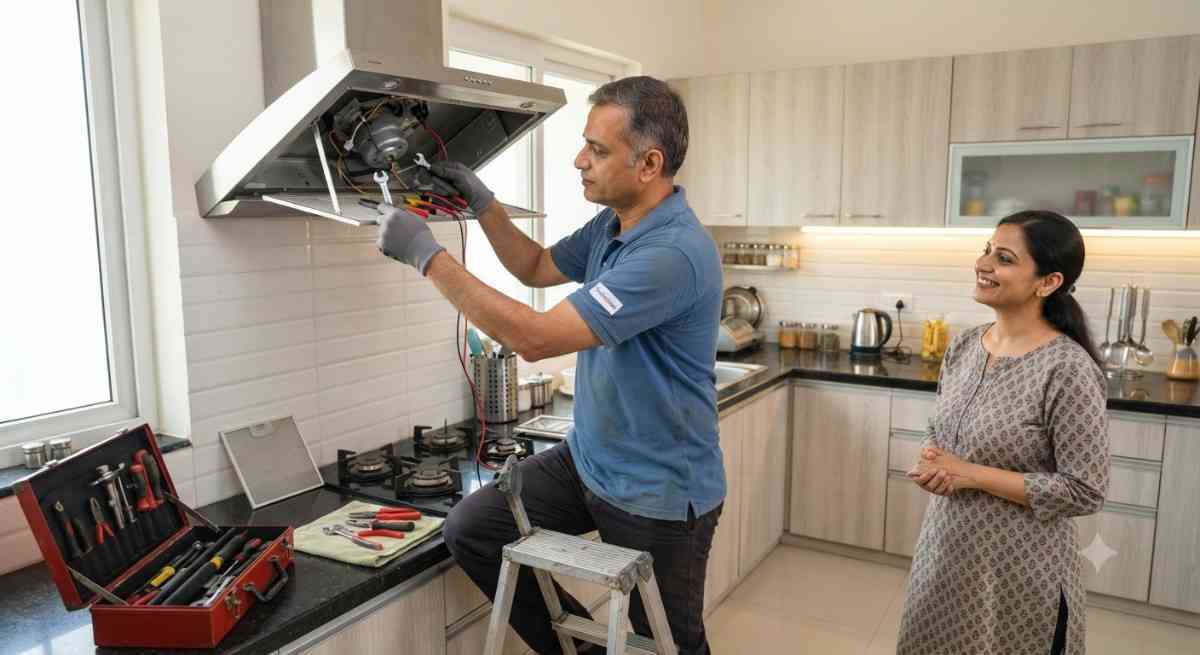
A common question before booking anyone: what actually happens once the technician arrives? It's a fair thing to want to know, especially since a chimney sits fixed to your wall and can't be carried off for repair like a smaller appliance.
The technician usually starts by asking what you've noticed — when the weak suction began, whether it's constant or comes and goes, any unusual sounds. That short conversation often narrows down the likely cause before any tools come out.
Next is a physical inspection: filters removed and checked, ducting examined as far as accessible, motor speed tested across settings, and a listen for any irregular sound at the blower. This is where the actual diagnosis happens, rather than a guess based on the symptom alone.
Once the cause is confirmed, you're given a clear cost before any repair work starts. A filter clean and degrease might take twenty to thirty minutes. A motor or capacitor replacement takes longer, and you'll know the part cost and labour separately so nothing is bundled into a single unclear number at the end.
The Most Common Culprit: Blocked Filters and Ducts
It's worth spending a little extra time on this one because it accounts for such a large share of the calls we get. Grease doesn't announce itself — it builds up gradually, coating the mesh in a thin film that thickens with every meal cooked without a clean.
By the time suction feels noticeably weak, the filter is often carrying weeks or months of build-up. The same applies to ducting, particularly in kitchens where the vent run includes a couple of bends before reaching outside — grease settles more readily at each turn.
The frustrating part is that a chimney with blocked filters sounds completely normal. The motor runs at its usual volume because the motor itself isn't struggling — it's the air simply has nowhere to go. That's exactly why "the chimney sounds fine but isn't pulling anything" is one of the most common descriptions we hear on a first call.
Genuine Parts vs Compatible Parts for Chimney Repair
This comes up on almost every motor or capacitor replacement: is it worth insisting on a genuine part, or is a compatible one good enough?
For the motor and capacitor specifically, genuine or closely-matched parts are the safer choice. These components are rated for a specific airflow and RPM, and a mismatched replacement can either underperform or put unnecessary strain on the unit.
For non-functional components — the outer casing, control panel buttons, decorative trims — a quality-tested compatible part is often functionally identical and noticeably cheaper, with no real downside.
A straightforward technician will tell you honestly which category your repair falls into, rather than defaulting to the more expensive option across the board. It's reasonable to ask to see the part before it goes in — a legitimate technician won't mind the question.
Filter Cleaning and Maintenance You Can Do Yourself
A meaningful share of chimney complaints never needed a technician in the first place — they needed regular cleaning. A few habits that genuinely help between service visits:

- Soak mesh filters in hot water with dish soap or a degreasing agent roughly every two to three weeks if you cook daily
- Use a soft brush rather than a scouring pad, which can damage the mesh over time
- Run the chimney on its highest speed setting for the first few minutes of cooking, when grease production is heaviest
- Wipe down the visible exterior and control panel regularly, especially after oil-heavy cooking
- Replace carbon filters on ductless models per the manufacturer's recommended schedule — these can't be washed and reused
- Book a full professional inspection roughly once a year, even if suction feels fine, to catch early motor or wiring wear
None of this replaces a proper service when something's actually gone wrong, but it does mean fewer emergency calls and a chimney that performs closer to its rated suction day to day.
Why Bangalore Homeowners Call Us for Kitchen Chimney Repair
There's no shortage of numbers to call when a chimney stops pulling smoke properly. Here's what we'd want to know if we were the ones searching:
Chimney-specific experience
Technicians handle motor, filter, and ducting faults regularly — not as a side task alongside ten unrelated appliance types.
Diagnosis before parts
You get a confirmed cause, not a guess dressed up as a diagnosis before any part is opened.
Transparent pricing
The cost is explained before work starts, every time, with no exceptions.
Warranty on the work
Every completed repair includes a service warranty period, confirmed at the time of booking.
None of this is unique to us — plenty of technicians can clean a filter or swap a motor. What tends to matter more over time is consistency: the same standard of diagnosis and pricing whether it's your first call or your fifth.
Areas We Cover
Our kitchen chimney repair coverage currently spans Whitefield, Electronic City, Koramangala, Indiranagar, JP Nagar, Jayanagar, HSR Layout, Marathahalli, Yelahanka, Hebbal, Banashankari, Rajajinagar, and Malleshwaram, with same-day slots usually available somewhere on that list.
Outside these areas? Message us on WhatsApp anyway — coverage keeps expanding, and we'll tell you honestly whether we can reach you before booking a visit we can't keep.
A Note on Brand Names
Worth stating plainly: this chimney repair service is run by Appliances Repairs, an independent third-party repair provider. We service chimneys from KAFF, Faber, Elica, Glen, Siemens, Bosch, Gilma, Kutchina, and Hindware among others, but we are not affiliated with, endorsed by, or authorised by any of these brands.
Each brand name belongs to its own trademark owner — we reference them here only because that's the chimney sitting in your kitchen, not because of any partnership between us.
One upside of that independence: we're not locked into any single brand's official pricing or turnaround windows, which often works out faster and more affordable. The trade-off is that a genuine part occasionally takes an extra day to source rather than being on hand instantly.
What Affects the Final Repair Cost
People often ask why one chimney repair costs a few hundred rupees and another costs several times that for what sounds like a similar complaint. A few factors explain most of the gap:
- Whether the fault is mechanical (filter, ducting) or electrical (motor, capacitor, wiring)
- How accessible the ducting and motor housing are in your specific installation
- Whether the part needed is a commonly stocked item or a model-specific one
- The age of the unit — older chimneys sometimes need parts sourced specially
- Whether it's a straightforward clean-and-adjust or requires partial disassembly of the unit
None of this is meant to justify a vague estimate. It's meant to explain why "it depends" is often the honest answer until someone has actually looked at the chimney.
Questions Worth Asking Before You Book Anyone
Whether you call us or someone else, a few questions tend to separate a reliable technician from a rushed one:
- Will you tell me the cost before starting the repair, or only after? The answer should always be before.
- Do you carry ID or a company reference I can verify? A legitimate technician won't hesitate here.
- What's the warranty on this specific repair, not just a general policy? Get the actual duration, not a vague "we offer warranty."
- Are you using a genuine or compatible part, and why? Both can be fine — the point is getting a straight answer.
These aren't complicated questions, but asking them upfront filters out a surprising number of problems before they happen.
Frequently Asked Questions
Is this an authorised chimney service centre in Bangalore?
No — we operate independently as a third-party repair provider, without certification or authorisation from any chimney brand.
Why does my chimney sound normal but not pull any smoke?
This almost always points to blocked filters or ducting rather than the motor — the motor keeps running at its usual sound level even when airflow is restricted.
How often should chimney filters be cleaned?
Every two to three weeks for daily cooking is a reasonable baseline, though households that cook with a lot of oil may need to clean more often.
Can a single weak-suction complaint mean the whole unit is failing?
Not usually. It's most often isolated to filters or ducting, which are the easiest and least expensive parts of the system to fix.
Do you carry spare parts with you, or order them separately?
Common parts — filters, capacitors, standard switches — are usually carried on the visit. Less common parts may need a short follow-up.
Is it safe to keep using a chimney that smells of burning?
No. Switch it off at the wall and get it inspected before running it again — this is one symptom that shouldn't wait.
Do you offer a warranty on chimney repairs?
Yes, every completed repair includes a service warranty period, confirmed by the technician at the time of booking.
Can I book by WhatsApp instead of calling?
Yes — message us directly on WhatsApp at +91 8104268556, or call our toll-free number 1800-210-2966.
Request a Callback
Fill this in and it opens WhatsApp with your details pre-filled — no separate app or account needed.
Submitting opens WhatsApp on +91 8104268556 with your details filled in — you send the final message yourself.
Related Pages
Kitchen Chimney Not Suctioning Properly?
Fast doorstep repair · Same-day visits · Transparent pricing